
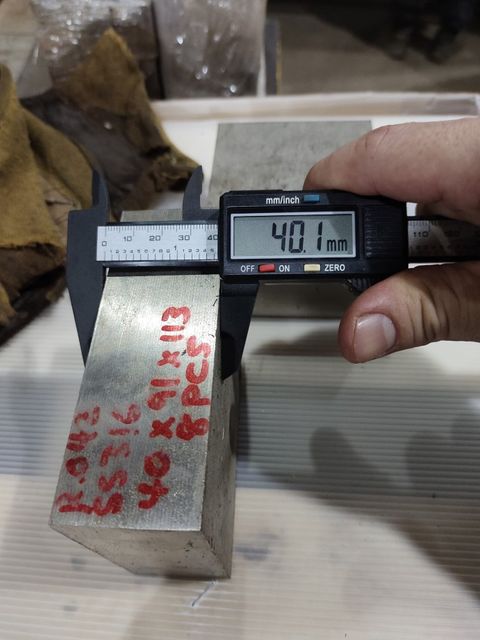
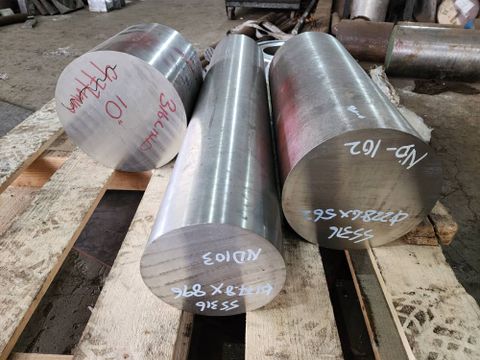


Stainless Steel 316 | SS316 | SS316L
Price:
R.F.Q.
Share Product:
Detail
Stainless Steel -
Grade 316, SUS316,UNS S31600
Chemical Formula
Fe, <0.03% C, 16-18.5% Cr, 10-14% Ni, 2-3% Mo, <2% Mn,
<1% Si, <0.045% P, <0.03% S
Background
SUS316
is the standard molybdenum-bearing grade, second in importance to SUS304
amongst the austenitic stainless steels. The molybdenum gives 316 better
overall corrosion resistant properties than SUS304, particularly higher
resistance to pitting and crevice corrosion in chloride environments. It has
excellent forming and welding characteristics. It is readily brake or roll
formed into a variety of parts for applications in the industrial,
architectural, and transportation fields. SUS316 also has outstanding welding
characteristics. Post-weld annealing is not required when welding thin
sections.
SUS316L,
the low carbon version of SUS316 and is immune from sensitisation (grain
boundary carbide precipitation). Thus it is extensively used in heavy gauge
welded components (over about 6mm). SUS316H, with its higher carbon content has
application at elevated temperatures, as does stabilised grade SUS316Ti.
Corrosion Resistance
Excellent in a range of atmospheric
environments and many corrosive media - generally more resistant than SUS304.
Subject to pitting and crevice corrosion in warm chloride environments, and to
stress corrosion cracking above about 60°C. Considered resistant to potable
water with up to about 1000mg/L chlorides at ambient temperatures, reducing to
about 500mg/L at 60°C.
SUS316 is usually regarded as the standard
“marine grade stainless steel”, but it is not resistant to warm sea water. In
many marine environments SUS316 does exhibit surface corrosion, usually visible
as brown staining. This is particularly associated with crevices and rough
surface finish.
Dual Certification
It is common for SS316 and SS316L to be stocked in "Dual Certified" form
- mainly in plate and pipe. These items have chemical and mechanical properties
complying with both SS316 and SS316L specifications. Such dual certified
product does not meet SS316H specification and may be unacceptable for high
temperature applications.
Physical characteristics
Density approximately 8.0 g/cm³
Excellent toughness, including at low temperatures
Generally non-magnetic in solution-annealed condition
Cold working can introduce measurable magnetism
Good formability and weldability when correct procedures are used
Heat treatment
316/316L cannot be hardened by conventional heat treatment. Solution annealing is commonly performed around 1040–1100°C followed by rapid cooling when restoration of corrosion resistance and microstructure is required after suitable processing.
For finished components, heat-treatment requirements should be reviewed against the applicable code or material standard.
SS316 vs SS316L: which should you choose?
Choose 316 when
The drawing specifically calls for 316 / S31600.
The component is not relying on low-carbon chemistry for welded HAZ performance.
The governing standard or engineering specification requires 316.
You need material certified specifically to the 316 grade requirements.
Choose 316L when
The component will be welded, especially in heavier sections.
You want lower carbon to reduce sensitisation risk.
Post-weld solution annealing is impractical.
The drawing specifies 316L / S31603 / 1.4404.
Can dual-certified 316/316L be used?
Often yes — when the material certificate demonstrates compliance with both requested grade requirements and the governing purchase standard accepts it. Dual certification does not automatically make the material interchangeable with 316H or other high-temperature variants.
Corrosion resistance
The molybdenum addition is the principal reason engineers step up from 304/304L to 316/316L when chloride or chemical exposure becomes more demanding.
Where 316/316L performs well
Many food and beverage processing environments
Pharmaceutical and hygienic equipment
General chemical processing equipment
Coastal atmosphere and marine hardware
Process water and moderately chloride-bearing environments
Equipment requiring improved pitting resistance over 304/304L
Important limitations
“Marine grade” does not mean immune to seawater corrosion.
Warm chlorides, stagnant crevices and high chloride concentration can still cause pitting or crevice corrosion.
Stress-corrosion cracking remains a consideration in hot chloride environments.
For severe chloride service, duplex or higher-alloy stainless grades may be more suitable.
Typical SS316 / 316L applications
Final material selection must consider temperature, chloride level, chemicals, fabrication route, required strength, surface finish and design code.
Semiconductor & electronics | Clean equipment parts, fixtures, brackets, process components and precision-machined hardware.
Chemical & petrochemical | Valves, pump parts, flanges, fittings, tanks and equipment exposed to corrosive process media.
Food & beverage | Processing equipment, tanks, fittings, shafts and components requiring cleanable corrosion-resistant surfaces.
Pharmaceutical | Process equipment, hygienic components, mixing hardware and precision fabricated parts.
Marine & coastal | Fittings, shafts and hardware where 304-class corrosion resistance is insufficient.
General precision engineering | Machined plates, bases, shafts, pins, fixtures and one-off or small-batch engineered components.
Cut SS316 / 316L to the size you actually need
For machined components, starting from a correctly sized blank can reduce material waste, handling and downstream machining time.
Bandsaw cut-to-size
Send your material grade, dimensions and quantity. E STEEL can quote full material or cut pieces based on available stock and the most suitable cutting route.
Plate and round-bar cutting
One-off, prototype and production quantities
Cutting list support
Heat-number and MTC traceability
Machining allowance can be agreed before cutting
What is the main difference between SS316 and SS316L?
Carbon content. 316 allows up to 0.08% carbon while 316L limits carbon to 0.03%. The lower-carbon 316L grade is commonly preferred for welded fabrication because it reduces the risk of sensitisation in the heat-affected zone.
Is SS316L magnetic?
Annealed 316L is generally considered non-magnetic or very weakly magnetic. Cold working, machining and forming can produce some magnetic response because part of the austenitic structure may transform during deformation.
Can SS316 or SS316L be hardened by heat treatment?
No. Conventional heat treatment does not harden austenitic 316/316L. Strength and hardness can increase through cold work. Solution annealing is used to restore the desired austenitic condition after suitable processing, not to harden it like martensitic stainless steel.
Is 316L better than 304L?
316L normally offers better resistance to pitting and crevice corrosion in many chloride-bearing environments because it contains molybdenum. That does not mean 316L is automatically the correct choice for every chemical, temperature or seawater application.
Can E STEEL cut SS316 / 316L to custom size?
Yes. E STEEL supplies full material and cut-to-size pieces. Send thickness × width × length for plate, or diameter × length for round bar, together with quantity and any machining allowance or specification requirements.
Can I buy only one piece?
Yes. E STEEL supports no-minimum-order requirements, subject to stock availability and the practical minimum charge for material and cutting.
Does SS316L come with a Mill Test Certificate?
Material can be supplied with EN 10204 3.1 Mill Test Certificate where applicable to the ordered stock. The certificate should be checked against the heat number, ordered grade, product standard and required properties.
Is dual-certified 316/316L acceptable?
It can be, provided the MTC shows the heat complies with both grade requirements and your drawing, customer specification or governing code accepts dual certification. Always confirm when the application is code-controlled.
Availability
| Supply Ability | 6000 mm / |
| Availability | In Stock |
Shipment
| Delivery Detail | Estimated delivery within 2 |
Payment
| Payment Term | Swift Transfer, Telegraphic Transfer (T/T), Bank Transfer, |
Catalogue Download